
BIM coordination: a success factor in digital construction projects
In digital construction projects, unclear responsibilities, a lack of coordination or inconsistent data can quickly lead to expensive risks. Overall BIM coordination (BGK for short) ensures maximum transparency and reliable decisions. In addition to technical tools and standards, it is based on careful organisation, smooth communication and central roles: Overall BIM coordinator and BIM coordinator.
This article shows how the overall BIM coordinator acts throughout the entire project — from preparation to delivery of the final models.

Categorisation of overall BIM coordination in the BIM process
The terms BIM management and overall BIM coordination are sometimes used interchangeably, but refer to different roles and responsibilities in the BIM process. BIM management takes place at a strategic and organisational level. It is intended to ensure that the entire BIM process runs according to defined standards, objectives and strategies throughout the project.
Overall BIM coordination
- ensures that the individual specialised models are correctly merged, checked and coordinated at the operational-technical level
- verifies interdisciplinary BIM content
- is responsible for the coordination model
- monitors the implementation of the specified tasks of the specialised coordination
The overall BIM coordinator is the link between the BIM manager (strategic) and the BIM coordinators and BIM authors/specialist modellers (operational). They take care of the specialist model coordination within a BIM project and are the main point of contact for digital planning vis-à-vis project management/BIM management.
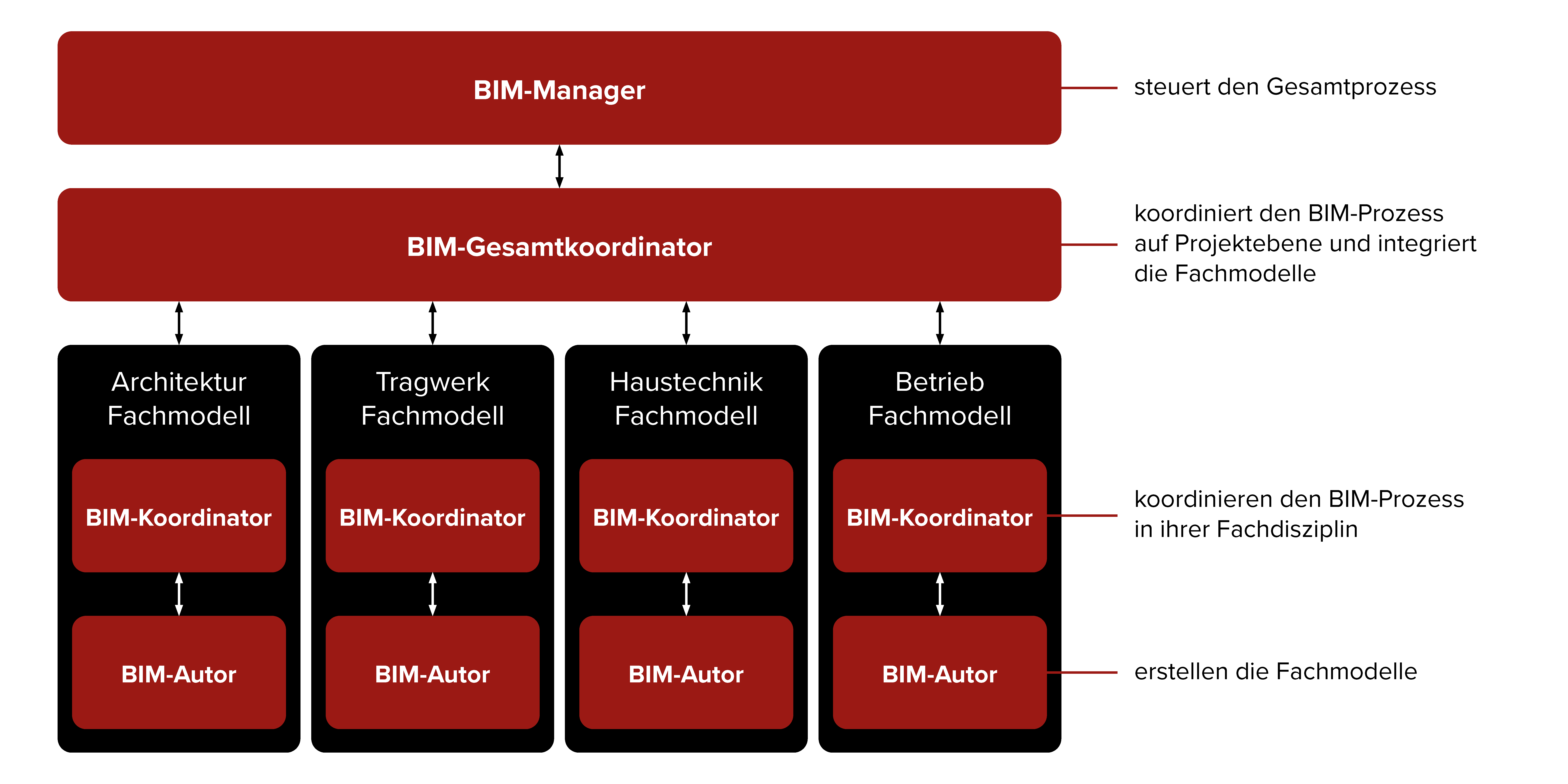
Overview of the roles in the BIM project
Overall BIM coordinator tasks in the individual phases
1. preparation and establishment of the BIM framework
In the first phase, the foundations are laid for the entire BIM process. This phase is crucial to ensure that all parties involved — architects, engineers, companies — work in a coherent and harmonised environment. A typical challenge at this stage is the different levels of BIM experience of those involved and knowledge of BIM guidelines and standards.
A BIM project can be compared to a hike: it has a start and an end point, but more or less large differences in altitude. At SOLTIC, we endeavour to ensure that the gradient is never too steep. We clarify and address all aspects so that the planning teams know from the kick-off in which direction we want to go.
Role, responsibilities and objectives
At the start of a BIM project, it is essential to define roles and responsibilities and to clarify expectations of the overall BIM coordinator. A uniform understanding of the BIM objectives among all project participants created in advance minimises conflicts of objectives between costs, quality and digital level of detail (LOD/LOI).
Defined processes ensure who delivers and checks which models as the project progresses. The overall BIM coordinator can also define various standards. The best known are those for naming conventions, the element plan and the model delivery programme.
Scheduling
Another key aspect is the synchronisation of project deadlines and milestones with the BIM coordination process. The model delivery programme defines when and to what extent the specialist models are provided. The specialist planners’ model deliveries are synchronised with the project phases and planned coordination cycles. This ensures that the necessary models are available in good time for the coordination and review processes. The overall BIM coordinator continuously monitors this schedule and informs the project team of any delays or deviations in model processing.
Training
One task that the overall BIM coordinator may take on concerns the training of the planning teams. In theory, BIM projects assume that all those involved are trained or have basic knowledge in this area. In practice, the situation is often different. Our experience shows that knowledge varies greatly or is sometimes even completely lacking. Our overall BIM coordinators support these teams in order to create good working conditions and successfully complete the project.
Technical framework conditions, software compatibility and data management
The overall BIM coordinator ensures that the technical framework conditions and software compatibility are harmonised in accordance with the selected BIM strategy (OpenBIM/ClosedBIM). Different software solutions and model formats, a lack of IT infrastructure or inadequate training of those involved would lead to disruptions in the project. It must also regulate access rights and the versioning of models.
Summarised
Before any modelling, the overall BIM coordinator ensures that the project context is clearly defined. This includes:
- the validation of the BEP (BIM Execution Plan)
- Creating the CDE structure (Common Data Environment) and setting up the issue management system
- the definition of modelling standards (element plan, IDS, level of detail, coding)
- Planning the DKS (digital coordination meetings)
2. collection and testing of the specialised models
Now each team creates its models (architecture, structure, building services, operation, etc.) according to the defined conventions. In this phase, the BIM coordinators receive the respective specialist models and check model statuses, versions, file formats, their content, etc. The BIM coordinators then hand over the specialised models to the overall BIM coordinator. They then merge them into a coordination model.
Central to the quality inspection are
- Model checks: Geometry, coding, classification, units
- Rule checks in accordance with BEP: plausibility, storey allocation, component labelling, etc.
- Correct and complete entry of information
BIM quality assurance
In the interdisciplinary coordination check, the overall BIM coordinator carries out collision checks between the specialist models (e.g. structural MEP). BIM software tools such as Navisworks or BIMcollab ZOOM identify interferences between the disciplines.
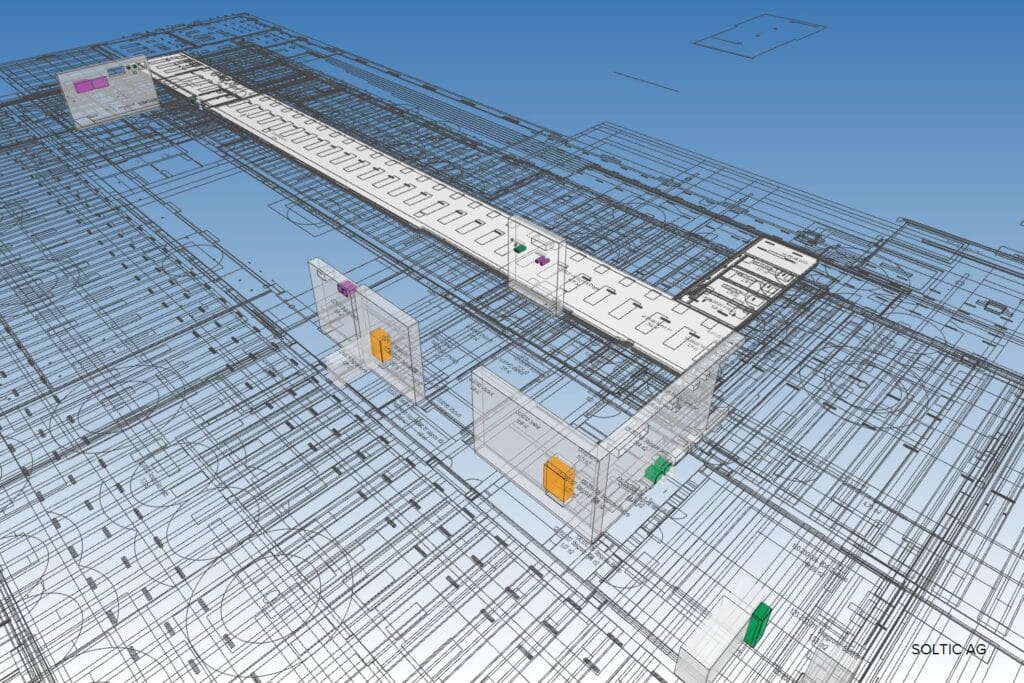
Illustration of automated conflict detection and tracking using smart issues in the coordination model

View of the BIM coordination model — visual control of the overlaps between the specialist disciplines using colour differentiation.
Challenges in practice
In our working environment, we move between two worlds — construction and mechanical engineering. Despite continuous software developments, the interfaces between the two areas are still not fully compatible. What is logical for one world is not necessarily logical for the other.
The IFC exchange format has become the standard in the construction industry, but not in mechanical engineering. Interoperability remains a problem that needs to be solved.
As soon as business models are available, we are required to find compromises in order to satisfy all parties involved. Our experience shows us that we cannot always limit ourselves to a coordination programme.
3. coordination meetings and issue management
The digital coordination meetings (DKS) take place at intervals determined by the project planning. The DKS serve to
- Presentation and discussion of the discovered clashes and issues
- Assignment of responsibilities
- Determination of correction deadlines
The overall BIM coordinator assumes the role of a technical mediator and, together with the BIM coordinators and specialist planners, ensures that all decisions are correctly documented and tracked
4. consolidation and validation
In the final phase, the overall BIM coordinator ensures that all technical models are consistent and correct after correction and validation.
The coordination model serves as a reference for meetings and audits and is used in particular for
- the spatial and functional inspection of the buildings
- the final conflict detection
- Creation of the digital planning and as-built model (as-built model)
The overall BIM coordinator checks the overall coherence before the model is passed on to the client.
Overall BIM coordinator: Conductor in the BIM project
A BIM project only works if all specialist disciplines work closely together — architects, structural engineers, technical building services planners, client representatives and contractors.
The role of the overall BIM coordinator can be compared to that of a conductor in an orchestra: Each specialist planner plays their own instrument — their own specialist model — but it is only through coordinated harmonisation that a harmonious whole is created.
The tasks of the overall BIM coordinator go beyond technical testing and pure model management: he is also a moderator, mediator and quality manager. They promote open, solution-orientated communication between the specialist disciplines. This ensures the quality of the information throughout the entire life cycle of the building — a key success factor in the BIM process.
Briefly summarised
BIM coordination is teamwork on a digital level, organised by the overall BIM coordinator. It combines technology, communication and quality into a functioning whole — and thus lays the foundation for a successful, collaborative construction project.
Conclusion
Effective BIM coordination depends as much on tools as it does on human communication. CDE platforms and issue management systems ensure traceability, but it is the structure of the process and the clarity of communication that make for successful coordination.
Our experience shows that the following factors are the key to effective and reliable BIM coordination:
- the regularity and consistency of BIM reviews
- the standardisation of formats (IFC, BCF)
- Transparency when tracking tasks
Coordinate precisely, realise efficiently
As General planner and thus overall manager SOLTIC sees overall BIM coordination as an essential prerequisite for the success of complex industrial construction projects. SOLTIC’s BIM experts are in charge of these projects from the initial model structure to the complete digital handover. As overall BIM coordinators, we ensure that technical precision, data quality and interdisciplinary collaboration are seamlessly integrated — for efficient planning processes and sustainable project results.
Do you want clarity in your digital construction project?

We look forward to hearing from you.
David Fischer
BIM Coordinator, Advanced Modeller